
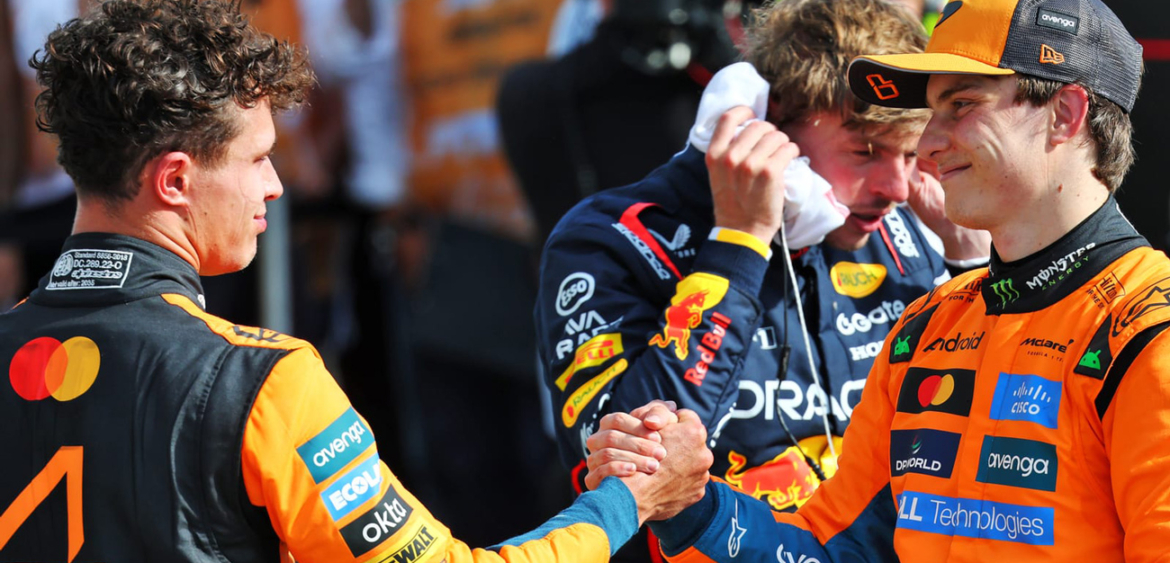

McLaren’s decision to ask Oscar Piastri to relinquish second place to Lando Norris at the Italian Grand Prix has sparked debate—and not without reason.
A slow pit stop for Norris allowed Piastri to jump ahead late in the race. McLaren then instructed Piastri to let Norris back through, a move the championship leader clearly didn’t appreciate but ultimately obeyed. The team cited last year’s Hungarian Grand Prix as precedent, but the comparison doesn’t quite hold.
In Hungary, the undercut was so potent that Norris was guaranteed to leapfrog Piastri by pitting two laps earlier under pressure from behind. At Monza, however, the undercut wasn’t nearly as effective. Norris would have retained position if not for the botched stop. As Piastri rightly pointed out, sometimes a slow pit stop is just part of racing.
This call from McLaren felt unnecessary—and worse, it feeds into the narrative of favoritism toward Norris. While McLaren has generally navigated intra-team dynamics well, this intervention seemed excessive. Not every twist of racing fortune needs to be corrected.
Had Piastri gained the position purely through strategy, the team might have had a stronger case. But the slow stop was the decisive factor, and that’s racing. Piastri’s compliance was probably pragmatic—preserving harmony within the team and sacrificing a few points that may not matter in the long run. Still, if the fight had been for victory rather than second, the calculus might have changed.
It’s worth noting that Piastri had just benefitted from a major points swing at Zandvoort due to Norris’s mechanical failure. That context likely made it easier to accept the team’s request. But if the championship battle were tighter, surrendering those three points would have been far more contentious.
As it stands, Piastri can reasonably conclude that maintaining team unity and respecting McLaren’s “racing principles” outweighs the personal cost. Yet the optics for McLaren are poor. The team appears to be stage-managing the championship, raising uncomfortable questions about fairness, luck, and the limits of team orders.
Trying to avoid the toxic rivalry that plagued Mercedes during the Hamilton-Rosberg era is understandable. But was Charles Leclerc truly such a threat that McLaren had to override pit stop priority? Is the constructors’ title really hanging in the balance to justify this level of interference?
Had Piastri suffered Norris’s misfortune, Leclerc might have snatched the final podium spot. But that’s the very definition of bad luck—something McLaren couldn’t have predicted or prevented.
Ironically, Piastri may have gained more than he lost. By complying, he avoided internal conflict and possibly earned goodwill. Still, McLaren’s decision was a tough ask and arguably a poor one, even if understandable in context.
On one level, it’s forgivable: the error wasn’t tied to Piastri’s side of the garage, the race wasn’t one he was likely to win, and the swap was executed cleanly with no threat from behind. But letting a title-contending driver lose ground due to a team error—especially after Norris’s reliability woes the previous week—would have been equally controversial.
The idea that McLaren is actively favoring Norris doesn’t hold much weight yet, nor do the slippery slope hypotheticals. But the team has opened a door it may struggle to close. What happens if a similar situation arises and the points swing could decide the championship?
McLaren has now intervened to correct what many would consider a racing incident. That’s easier to justify when the stakes are low. But it sets a precedent. Will McLaren continue to intervene when the title is on the line? Or will it back off, having already tilted the scales?
Motor racing is inherently chaotic. Piastri wasn’t at fault for the six-point swing he was about to benefit from, and McLaren—given its dominant position—felt compelled to act. But where does it end?
Should McLaren now send Piastri out with a faulty engine to balance Zandvoort? Should Norris be ordered to take a detour through the gravel at Melbourne to even things out? Should McLaren lobby the FIA to withdraw all other cars to prevent slipstreams or collisions from influencing the title?
Of course not. The absurdity of trying to engineer fairness in a sport built on unpredictability is precisely the point. Maybe the only truly fair solution is to park both drivers for the rest of the season—then no one gains an unfair advantage.
But short of that, McLaren must tread carefully. Because once you start correcting for luck, you risk undermining the very essence of racing.